
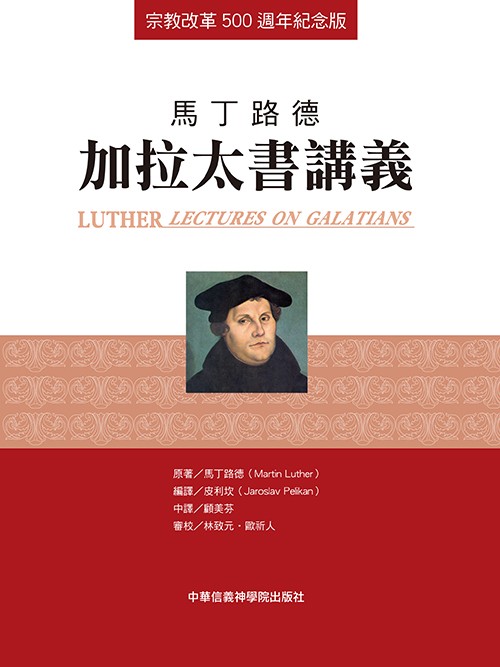
馬丁路德「加拉太書講義」
作者: 馬丁路德
譯者:皮利坎、顧美芬
出版社: 中華信義神學院
Luther Lectures on Galatians
Author: Martin Luther
Translator: Jaroslav Pelikan, Mei Fen Gu
Publisher: CLS
馬丁路德「加拉太書講義」
正如使徒保羅的加拉太書被稱為基督徒自由的大憲章,馬丁路德於西元1535年出版的加拉太書講義被稱為改教的大憲章。在天路歷程作者約翰本仁的自傳「蒙恩的罪魁」中,提到「除了聖經,馬丁路德的加拉太書是我讀過最喜歡的書,它最能撫慰受傷的良心」。路德的加拉太書講義正如使徒保羅的加拉太書信,充滿了獨特的自傳性敘述。在很多方面這兩位上帝的子民志趣相投,對他們的對手激烈的批判,但從未失去基督愛的眼光,藉著道帶來的上帝救贖信息。這是一部五百年前寫就的“經典”,但並不晦澀難懂、離我們很遙遠,直至今日,這本書仍在影響無數基督徒的個人生命。它跨越了歷史之時空,以直接熱情的文風,直抒胸臆,直指人心,對每一位聖徒、對今天的我們說話。它對我們信仰生活的實用性和適切性是跨越時代的,就仿佛正對著我們當下的掙扎與困惑說話。以致有人評論這本書為「五百年不熄的一盞明燈」。
使徒保羅所寫的加拉太書,只有短短的六章共149節,但路德版的講解(1535年)卻超過六百頁,中英文版皆然。平均每章用一百頁,每節平均用四頁的內容加以註解說明;當然,這裡說的是「平均」,實際上並沒有那麼機械化的呈現。例如,第三章的講解內容最長,占全書四分之一強,因為該章確實包含全書最核心的內容。路德生平至少出版過六次加拉太書講解,其中只有兩本被放在1950及60年代英文版的《路德文集》內。而本書所根據的1535年版正是他最為成熟,對保羅信息所作嚴謹、熱切、敏銳的詮釋;不僅逐節,甚至逐句,類似現代典型的聖經註釋。路德對自己的重要定位,在於他是聖經的講解、詮釋者。他認為聖經不單要從歷史背景加以了解,更要應用在當下信徒生活中;否則聖經就被置於冰冷、死寂狀態中。本書講解的方式,可說具體實踐了路德自己的理念。路德雖自認為他的註釋並不完備,表達上有點「囉嗦」,然而近代新約學者貝茨(Hans Dieter Betz)依舊給予高度評價,認為本書內容對於保羅信息展現出非凡、深刻的理解。貝茨甚至認為,保羅若處於路德的年代,他所說的就是路德書中的內容。當代華人學者與信徒,相信都可從路德的講解中,深深獲益。
──廖元威
中華福音神學院歷史與神學副教授
馬丁路德的「加拉太書講義」經常被稱為「偉大的加拉太書注釋書」(”The Great Galatians Commentary”),是因為在近五百年來的改教運動中帶給教會巨大的影響。「加拉太書講義」呈現出改教者的成熟神學,這可說是改教運動中,基督新教原汁原味的神學思想。馬丁路德講授「羅馬書講義」(1515-1516年)可說是在發展的階段,然而「加拉太書講義」(1531年)則已經進入信念堅定的狀況。「羅馬書講義」是在張貼95條之前,也就是在正式改教之前發表的,感覺像是改變中的路德所寫的屬靈日記,許多的關鍵議題都還未達完全成熟的階段,而「加拉太書講義」則是思想已達成熟的路德,在信念堅定下所寫的著作。當路德在1531年講授「加拉太書講義」時,他已經歷過許多重要的屬靈經驗。這些經驗就是:1521年的沃木斯會議、1525年的農民戰爭、1525年與伊拉斯姆的辯論、1529年馬爾堡的對談與大小問答、1530年奧斯堡信條及與狂熱分子的衝突……等等。這些公開的挑戰以及路德個人的屬靈爭戰與經歷,形塑了他的神學思想,漸臻於完全成熟,並綻放出多面性璀璨的光芒。路德的整體神學全然彰顯基督的福音,好像光芒璀璨的鑽石;每一項主要神學的議題就像鑽石的切割面,彰顯精彩與豐富的福音多元面向,各面向的連結在在都可以讓人見證基督的福音。這些呈現在「加拉太書講義」中的神學議題就是因信稱義、唯獨信心、唯獨恩典、唯獨聖經、外來的義、兩種義、基督徒的自由、施恩具、基督為中心、律法與福音、同時是罪人和義人、稱義與成聖、兩國論、福音為應許、信徒皆祭司、十字架神學…等。除了神學思想之外,路德誠摯關懷的牧者之心以及切身經歷的屬靈經驗,對後世影響亦深,因為他將基督新教原汁原味的神學思想活了出來。路德的「加拉太書講義」,是這五百年來能夠對基督的信徒產生巨大影響的著作。深願信實的讀者在閱讀時,透過「加拉太書講義」中福音多元面向的璀璨光芒,能夠經歷到改革的熱忱,並得到信心的更新。
── 歐祈人
中華信義神學院新約老師
Luther Lectures on Galatians
Just as the Apostle Paul’s Galatians is considered the Magna Carta of Christian freedom, Martin Luther’s lectures on Galatians, published in 1535, are considered the Magna Carta of the Reformation. In his autobiography, The Pilgrim’s Progress, author John Bunyan mentions that “besides the Bible, Martin Luther’s Galatians is my favorite book; it best soothes my wounded conscience.” Luther’s lectures on Galatians, like the Apostle Paul’s Galatians, are filled with unique autobiographical narratives. In many ways, these two children of God shared similar interests, fiercely criticizing their opponents, but never losing sight of Christ’s love and the message of God’s redemption brought by the Word. This is a “classic” written five hundred years ago, but it is not obscure or distant; even today, this book continues to influence the personal lives of countless Christians. It transcends time and space, expressing its sentiments directly and passionately, speaking to every saint and to us today. Its practicality and relevance to our faith life transcends time, as if speaking directly to our current struggles and confusions. Some have even described it as “a beacon that has burned for five hundred years.”
The Apostle Paul’s Galatians is only six chapters long with 149 verses, but Luther’s commentary (1535) exceeds six hundred pages, in both the Chinese and English versions. On average, each chapter has one hundred pages, and each verse has an average of four pages of annotation; of course, this is an “average,” and the actual presentation is not so mechanical. For example, the commentary on Chapter 3 is the longest, comprising more than a quarter of the entire book, as it truly contains the core content. Luther published at least six commentaries on Galatians during his lifetime, only two of which were included in the 1950s and 60s English editions of Luther’s Collected Works. The 1535 edition, on which this book is based, represents his most mature, rigorous, fervent, and insightful interpretation of Paul’s message; it goes not only verse-by-verse but even sentence-by-sentence, resembling a typical modern biblical commentary. Luther’s key self-positioning lay in his role as a commentator and interpreter of the Bible. He believed the Bible should not only be understood within its historical context but also applied to the lives of believers in the present; otherwise, it would be relegated to a cold, lifeless state. The method of explanation in this book embodies Luther’s own philosophy. Although Luther considered his commentary incomplete and somewhat “verbose,” modern New Testament scholar Hans Dieter Betz still highly praised it, believing the book demonstrates an extraordinary and profound understanding of Paul’s message. Betz even argued that if Paul had lived in Luther’s time, what he said would be exactly what Luther wrote. Contemporary Chinese scholars and believers can undoubtedly benefit greatly from Luther’s explanations.
—Liao Yuanwei, Associate Professor of History and Theology, China Evangelical Seminary
Martin Luther’s “Lectures on Galatians” is often called “The Great Galatians Commentary” because of its enormous influence on the church during the Reformation movements of the past five hundred years. The “Lectures on Galatians” presents the mature theology of the Reformers, representing the authentic theological thought of Protestantism during the Reformation. While Martin Luther’s lectures on Romans (1515-1516) can be considered a developmental stage, the “Lectures on Galatians” (1531) represent a state of unwavering conviction. The “Lectures on Romans,” published before the posthumous of the 95 Articles—that is, before the formal Reformation—feels like a spiritual diary written by Luther during his transformation, with many key issues not yet fully mature. The “Lectures on Galatians,” however, are a work written by a Luther whose thinking had matured and whose conviction was unwavering. When Luther lectured on Galatians in 1531, he had already experienced many important spiritual events. These experiences included: the Congress of Worms in 1521, the Peasants’ War in 1525, the debate with Erasmus in 1525, the Marburg Dialogue and Questions and Answers in 1529, the Augsburg Creed in 1530, and conflicts with fanatics, among others. These public challenges, along with Luther’s personal spiritual struggles and experiences, shaped his theological thought, gradually bringing it to full maturity and revealing its multifaceted brilliance. Luther’s overall theology fully embodies the Gospel of Christ, like a dazzling diamond; each major theological issue is like a facet of that diamond, showcasing the rich and diverse aspects of the Gospel, and the connections between these aspects all allow one to witness to the Gospel of Christ. The theological topics presented in Luther’s “Lectures on Galatians” include justification by faith, faith alone, grace alone, Scripture alone, foreign righteousness, two kinds of righteousness, Christian freedom, instruments of grace, Christ-centeredness, law and the gospel, being both sinner and righteous, justification and sanctification, the two dichotomies, the gospel as a promise, all believers as priests, the theology of the cross, and so on. Beyond his theological thought, Luther’s sincere concern for his pastoral duties and his personal spiritual experiences have profoundly influenced posterity, as he brought to life the authentic theological thought of Protestantism. Luther’s “Lectures on Galatians” is a work that has had a tremendous impact on believers of Christ for the past five hundred years. It is deeply hoped that faithful readers, through the brilliant light of the multifaceted aspects of the gospel in “Lectures on Galatians,” will experience the zeal of reformation and receive a renewal of faith.
— Ou Qiren, New Testament Teacher, China Lutheran Theological Seminary
目錄 Table of Contents
歐序
中譯者序
路德文集總序
路德文集第26冊簡介
路德文集第27冊簡介
加拉太書講義
路德的加拉太書講義序文(1535)
加拉太書講義
聖保羅致加拉太人書的立論
加拉太書第一章
加拉太書第二章
加拉太書第三章
加拉太書第四章
加拉太書第五章
加拉太書第六章
經文索引
人名與主題索引
Preface by the European Author
Translator’s Preface
General Preface to the Collected Works of Luther
Introduction to Volume 26 of the Collected Works of Luther
Introduction to Volume 27 of the Collected Works of Luther
Lectures on Galatians
Preface to Luther’s Lectures on Galatians (1535)
Lectures on Galatians
The Foundation of St. Paul’s Epistle to the Galatians
Galatians Chapter 1
Galatians Chapter 2
Galatians Chapter 3
Galatians Chapter 4
Galatians Chapter 5
Galatians Chapter 6
Index to Text
Index to Names and Topics
詳細資料 Other Book Details
ISBN:9789869099066
出版日期: 2017 年 05 月 01日
頁數: 680 頁
尺寸: 170 mm x 230 mm
重量: 980 克
語言:繁體中文
裝幀: 精裝
適用對象: 適用所有人
ISBN: 9789869099066
Publication Date: 05-01-2017
Pages: 680 pages
Dimensions: 170 mm x 230 mm
Weight: 980 grams
Language: Traditional Chinese
Binding: Hardcover
Target Audience: All People
作者簡介 About the Author
馬丁路德(Martin Luther, 1483-1546),曾為天主教會奧古斯丁修會修士,因發現聖經中「藉恩因信稱義」的真理(藉耶穌基督全然的赦罪恩典,人透過上帝所賜之信心領受,而被上帝稱為義),反對羅馬天主教會高舉善工為得救必要條件,及教宗無誤之論調。
這位集聖經學者、牧師、神學家於一身的教會改革先鋒,無意之間在德國及全歐洲,帶起了一股教會更新運動,成為教會改革的先驅。
路德著述頗豐,無論護教短文、信箴、小冊子、文章專論、講道稿、談話錄(桌邊談)、聖經講義、神學著作,均為維護上帝純正話語,為不同的讀者而寫。他關注上帝話語純正的宣講及教導,甚於一切。後代研究路德神學觀及教會改革時期的學者也發現,這位上帝子民的牧者,在他所處的時代中,確實為教會留下了紮實的釋經、牧養及神學遺產。
Martin Luther (1483-1546), a member of the Augustinian Order of the Catholic Church, discovered the biblical truth of “justification by grace through faith” (justification through the full forgiveness of sins by Jesus Christ, received through faith given by God, and thus justified by God). He opposed the Roman Catholic Church’s exaltation of good works as a necessary condition for salvation and the papal assertion of inerrancy.
This pioneering figure of church reform, combining biblical scholarship, pastor, and theologian, unintentionally sparked a church renewal movement in Germany and throughout Europe, becoming a forerunner of church reform.
Luther was a prolific writer, producing apologetics, maxims, pamphlets, essays, sermons, tabletop talks, Bible lectures, and theological works, all written to uphold the pure word of God and for diverse readers. He prioritized the pure preaching and teaching of God’s word above all else. Later scholars who studied Luther’s theology and the period of the Church Reformation also found that this shepherd of God’s people did indeed leave a solid legacy of exegetical, pastoral, and theological knowledge for the church in his time.

